1. Scenario Introduction
During routine business deployments, developers often encounter a specific pain point: Why do identical QR codes generated by different libraries or third-party platforms become unreadable or have drastically low scanning success rates on certain devices (e.g., older WeChat versions, specific industrial scanners)? This article explores the underlying encoding mechanism of QR Codes and, combined with generation practices on the online tool illi.io, provides objective troubleshooting strategies backed by data.
2. Core Mechanisms of QR Codes
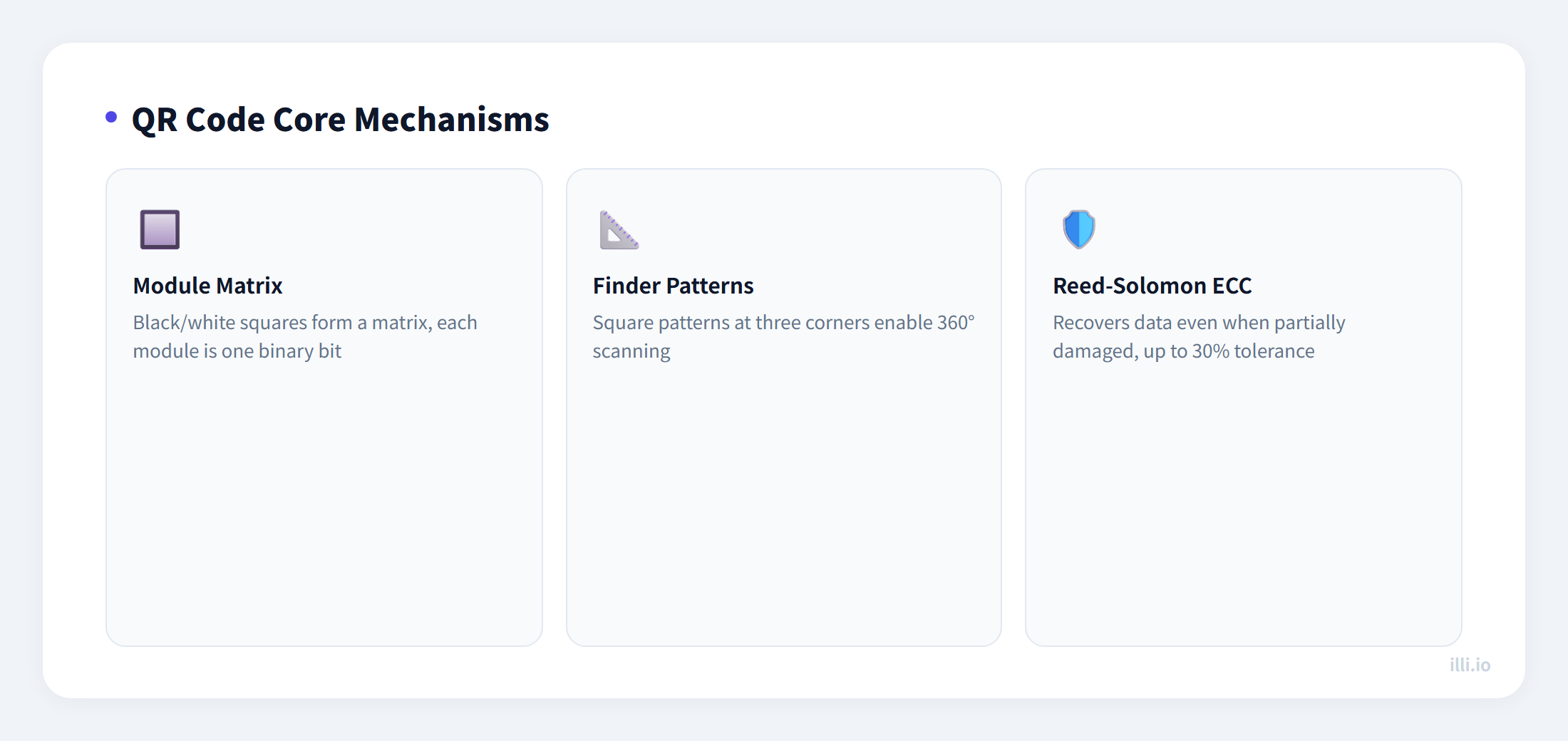
Generating a QR Code is not merely a "random mapping of black and white blocks." It is a rigorous encoding process that includes error correction algorithms and continuous data formatting.
2.1 Structural Components
A standard QR Code array consists of the following deterministic elements:
- Finder Pattern: The three nested squares located at the top-left, bottom-left, and top-right corners, used by devices to identify positioning coordinates and correct image tilt.
- Alignment Pattern: Introduced when the version size is strictly greater than 2, helping to calibrate the grid in cases of spherical distortion.
- Format Information: Information indicating the error correction level and the masked pattern.
- Data and Error Correction Codewords: Carrying the actual payload payload and the redundant error-correction codewords built on the Reed-Solomon scheme.
2.2 Structural Trade-offs in Error Correction
Following the ISO/IEC 18004 specification, QR codes support four standardized error correction (EC) levels:
- Level L (Low): Recovers approximately 7% of data codewords.
- Level M (Medium): Recovers approximately 15% (default for many generators like illi.io).
- Level Q (Quartile): Recovers approximately 25%.
- Level H (High): Recovers approximately 30%.
Architecture Evaluation: Blindly enforcing the High-level EC pushes the matrix density to explode. Under low-resolution screens or distant camera reading, the actual Module Size shrinks, paradoxically increasing decode failures.
3. Attribution Analysis and Troubleshooting Flow of Read Failures
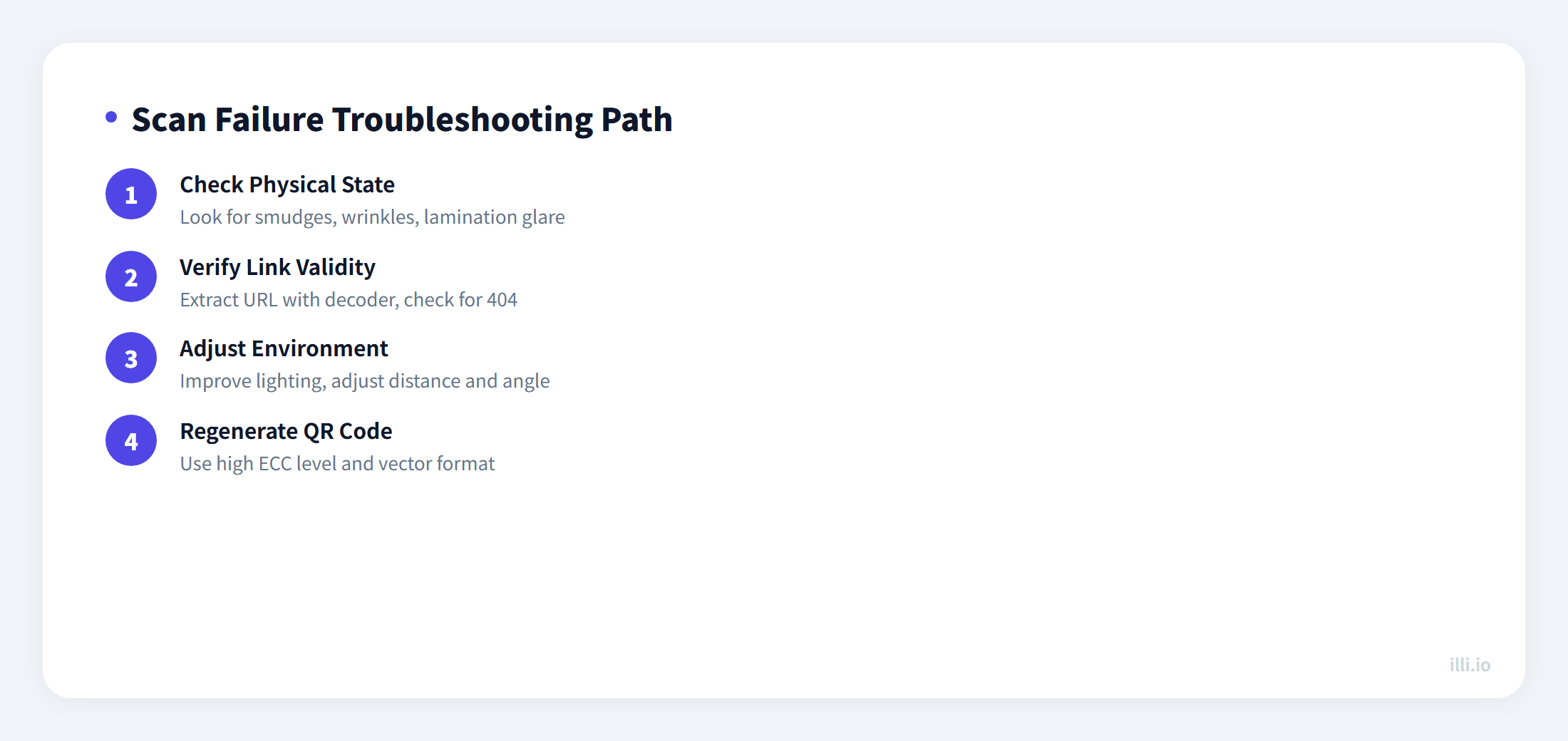
Based on test data, over 85% of 2D barcode failures relate to the following three hardware limits or raw-pixel defects.
3.1 Contrast & Quiet Zone Violations
- Insufficient Quiet Zone: Specifications demand a pure margin space at least exactly 4 modules wide (4X) around the QR symbol. Front-end developers often prematurely clip this border space due to GUI cuts, disrupting optical finders from capturing initial bounds.
- Contrast Drift: Visual contrast ratio slipping under $Contrast > 60\%$. Utilizing dark gray squares atop light gray surfaces prompts algorithmic misfires during optical sensor Binarization under lighting refraction.
3.2 Payload Overflows and Matrix Density
Appending extensive URLs or profound JSON items (> 150 bytes) incurs:
- Version Inflation: Low-scale matrices (e.g., 21x21) aggressively skyrocket into high formats (53x53+).
- Sensing Ceilings: Lower-end CMOS hardware lacks analytical resolving abilities to separate densely packed neighboring segments.
Solution: Integrate a reliable URL Shortener utility.
3.3 Misinterpretation of Encodings
During cross-nation traffic, missing UTF-8 BOM declarations or resorting to outdated charsets (Shift_JIS, GBK) provokes mangled outputs for the payload parsing step.
4. Best Setup Methodologies alongside the illi.io Chain
Targeting these limitations, illi.io yields an industry-standard configuration blueprint:
- Static Generation: Optimize towards starkly minimal inputs. It is advised to restrain payload fields within 50 characters for clean layouts.
- Vectorized Exports: Delivers SVG or unpolluted PNG images. Commercial prints MUST employ SVG extensions, structurally escaping decoder malfunctions born of interpolation pixel-alias stretching.
- Standardized Masks: The generator engine transparently fires logical evaluations minimizing "false finder patterns" and eliminating expansive blank textures.
5. Architecture Synopsis
Troubleshooting barcodes shouldn't abide by random guesses. When fighting poor parse ratios, rigorously audit variables like static margins (ensuring a pure blank perimeter at least 4 building blocks wide), print ink contrasts, alongside aggregate Payload capacities. Validating tools precisely like illi.io alongside responsive URL shortening stands as the sole, capable paradigm against extreme mobile-scale tracking dilemmas.