The Birth of the QR Code: Denso Wave
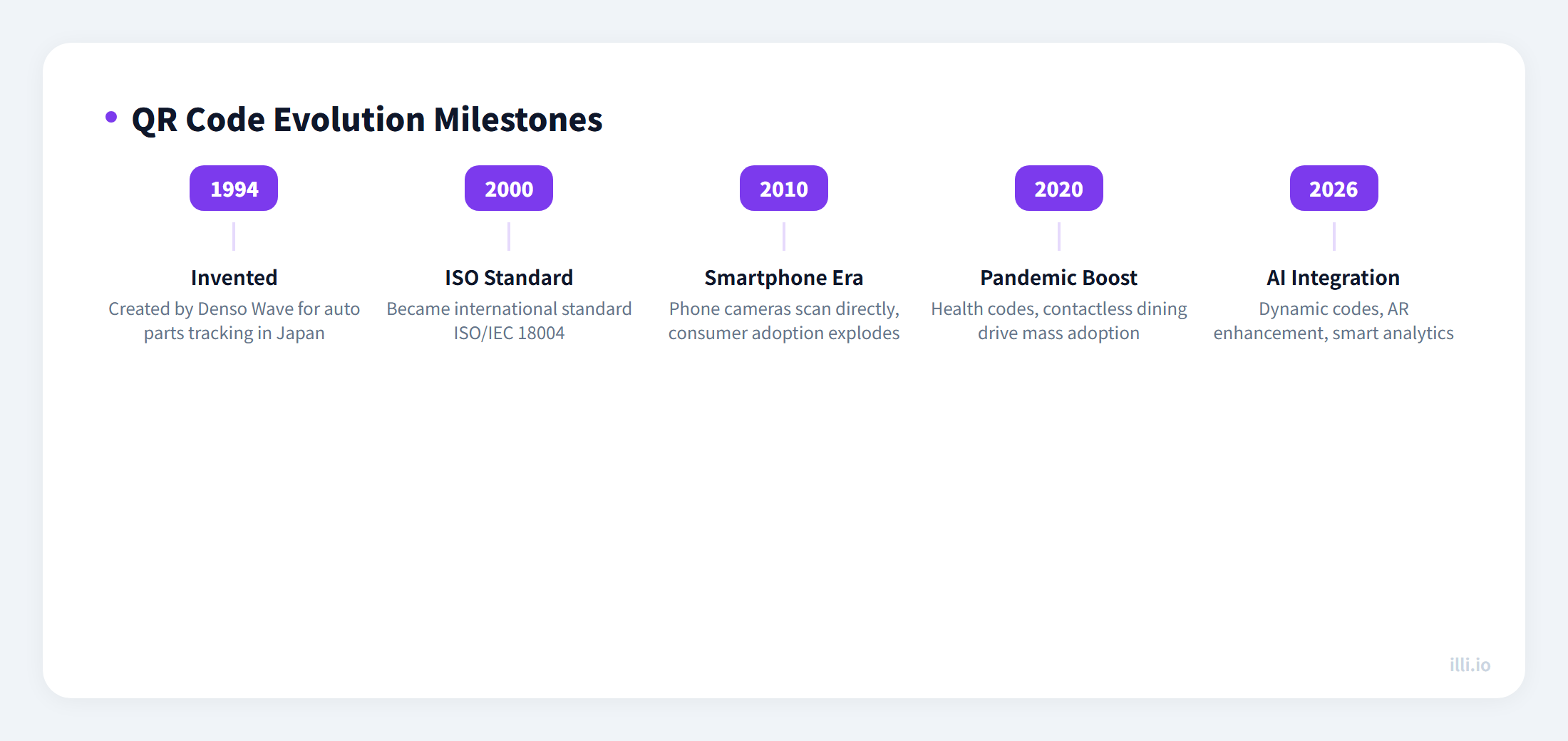
In 1994, engineer Masahiro Hara at Denso Wave, a subsidiary of Toyota, faced a critical bottleneck: traditional 1D barcodes could only hold about 20 characters, forcing factory workers to scan multiple barcodes per component. This was tedious, error-prone, and slowed down production lines.
Drawing inspiration from the black-and-white grid of the board game Go, Hara designed the QR (Quick Response) code — a two-dimensional matrix that stores data both horizontally and vertically. The result was revolutionary: a single QR code could hold over 7,089 numeric characters or 4,296 alphanumeric characters — more than 100 times the capacity of a standard barcode — and could be scanned at high speed from any angle.
Technical Architecture: What Makes QR Codes So Robust
The engineering behind QR codes is both elegant and resilient. Every QR code contains several critical structural components:
- Finder Patterns: The three large squares in the corners allow scanners to instantly locate the code's boundaries and orientation, regardless of the scanning angle. These are the most recognizable visual feature of any QR code.
- Alignment Patterns: Smaller squares distributed across the matrix correct for image distortion caused by curved surfaces or lens aberration.
- Timing Patterns: Alternating black-and-white module strips help decoders pinpoint the exact coordinates of each data module.
- Reed-Solomon Error Correction: This is the backbone of QR code resilience. Depending on the error correction level (L/M/Q/H), a QR code can still be fully decoded even if 7% to 30% of its surface is damaged, smudged, or obscured.
The Quiet Expansion and the Open-Source Gambit
Denso Wave made a fateful strategic decision: they chose not to exercise their patent rights. This meant any company or individual worldwide could use QR code technology without paying licensing fees. This open-access policy directly fueled the global proliferation of QR codes.
However, consumer adoption was far from instant. In the early 2000s, low-resolution phone cameras, underpowered processors, and the need to download dedicated scanning apps created significant friction. It wasn't until the early 2010s — with the advent of high-definition smartphone cameras, powerful chipsets, and native camera integration — that QR codes truly transitioned from industrial tools to everyday utilities.
In Asia, adoption outpaced the West dramatically. Japanese and Korean carriers began embedding QR readers into phones as early as 2002. In China, WeChat and Alipay transformed QR code payments into a national habit, building the world's largest QR code ecosystem.
The Pandemic Catalyst
The COVID-19 pandemic in 2020 became the single most transformative event in QR code history. Touchless interaction shifted from a convenience to a survival necessity:
- Hospitality: Physical menus vanished almost overnight, replaced by table-side QR codes that let diners browse, order, and pay without any physical contact.
- Public Health: Governments worldwide deployed QR-based health passes, contact tracing systems, and vaccination passports, making QR codes a pillar of public health infrastructure.
- Retail & Payments: To minimize the handling of cash and cards, QR code payment transactions surged globally — growing over 300% year-over-year in 2020 according to industry reports.
- Education & Work: Meeting links, class check-ins, and document sharing all adopted QR codes as quick-access portals.
Simultaneously, Apple (from iOS 11) and Google (from Android 9) natively integrated QR code scanning into their default camera apps, eliminating the last barrier to mainstream adoption: the need to download a third-party app.
The Future of the Matrix: Dynamic Codes and AI Fusion
QR code evolution is far from over. The most cutting-edge developments include:
- Dynamic QR Codes: Unlike static codes, dynamic QR codes allow the destination URL to be changed at any time without reprinting. This is critical for marketing campaigns — you can adjust landing pages in real-time and track detailed analytics including scan counts, geographic locations, device types, and time-of-day patterns.
- Artistic QR Codes: Leveraging AI generation techniques, QR codes are breaking free from the black-and-white square aesthetic. Designers and AI engines can seamlessly blend brand logos, artistic patterns, and even photographs into the QR matrix while maintaining full scannability.
- Encryption & Anti-Counterfeiting: In high-security applications, QR codes now carry encrypted payloads for product traceability, anti-counterfeiting verification, and digital identity authentication. Blockchain integration enables each QR code to correspond to an immutable on-chain record.
- Micro QR Codes: For extremely small surfaces like electronic components, the ISO 18004 standard defines Micro QR variants that require only one finder pattern, dramatically reducing the minimum printable size.
The thirty-year evolution of the QR code is far more than the triumph of an encoding technology — it is a textbook case of open-source philosophy, market timing, and technological progress converging perfectly. From Toyota's assembly line to the screen in your hand, this unassuming black-and-white matrix has fundamentally transformed how humanity interacts with information.