In the family tree of linear barcodes, Code 128 holds the undisputed crown as the "most powerful general-purpose 1D barcode" thanks to its unmatched character set coverage and encoding density. It can encode all 128 ASCII characters — uppercase and lowercase letters, digits 0-9, all standard punctuation, and invisible control characters like carriage return and line feed. This makes it capable of handling virtually every encoding requirement you'll encounter in supply chains and industrial automation.
Compared to older standards like Code 39, Code 128 encodes the same data in less than half the physical length. This means that on space-constrained labels (courier waybills, small pharmaceutical bottles, circuit board stickers), Code 128 can pack more information into a smaller footprint.
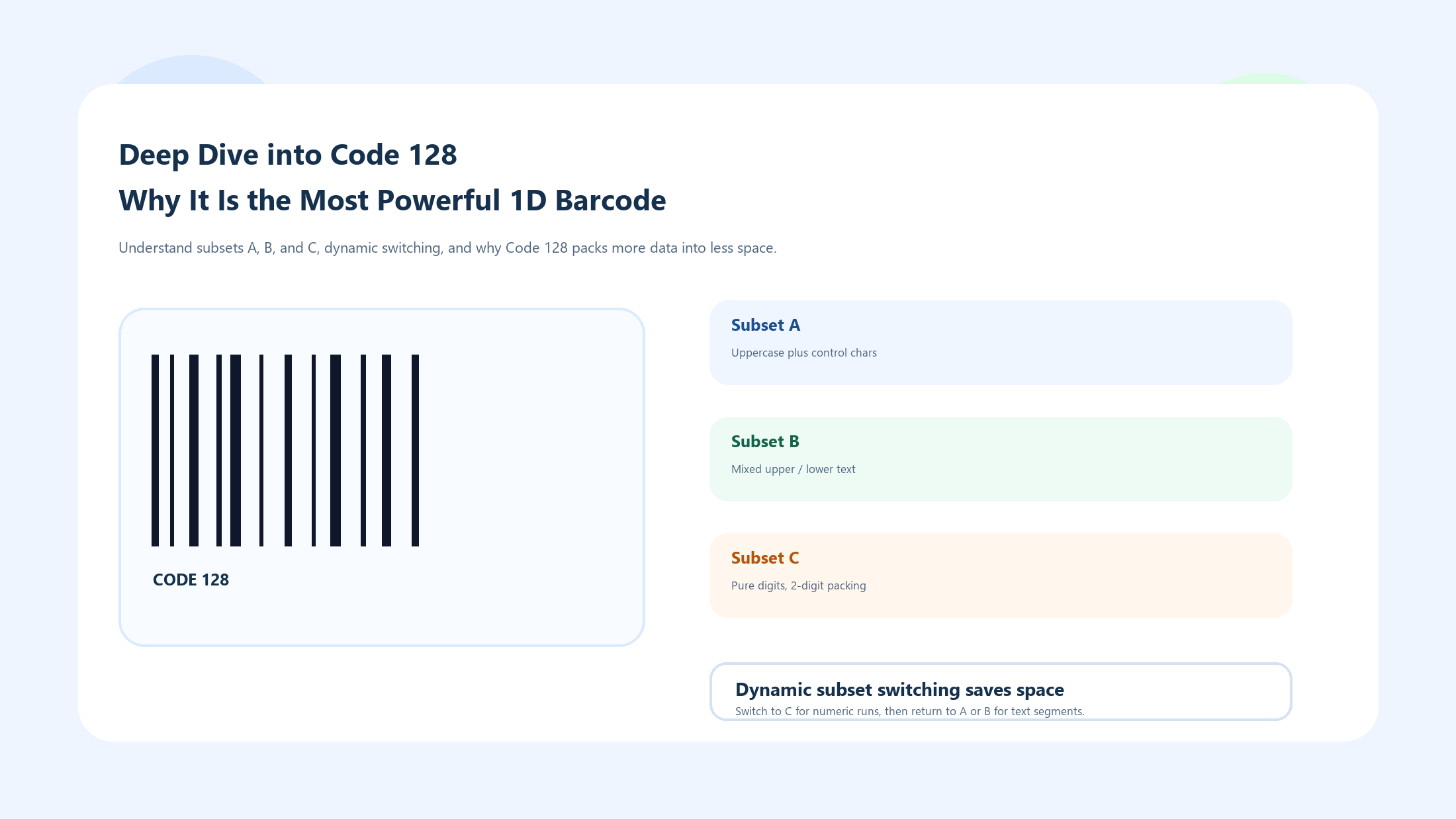
Code 128 stands out not only because it supports more characters, but because it can switch between subsets A, B, and C to encode complex data in a shorter symbol.
The Three Subsets: Decoding A, B, and C
The secret behind Code 128's exceptional density lies in three internal character subsets that the encoder can dynamically switch between during the encoding process:
Subset A (Code A)
Supports uppercase letters A-Z, digits 0-9, standard punctuation, and ASCII control characters (TAB, CR, LF, etc.). It is the only subset that can encode control characters.
Typical use: Text data containing line breaks or tab characters, such as command formats in legacy industrial device protocols.
Subset B (Code B)
Supports both uppercase and lowercase letters A-Z and a-z, digits 0-9, and standard punctuation. It is the most frequently used subset in practice, since most non-pure-digit encoding needs involve mixed-case text.
Typical use: Product code abbreviations (e.g., "AcmeCo-Widget-v3"), serial numbers, warehouse shelf IDs.
Subset C (Code C)
Exclusively designed for high-speed encoding of pure numeric data. It packs every two digits into a single barcode symbol, effectively doubling encoding efficiency. For example, encoding "123456" (6 characters) requires 6 codewords in Subset B but only 3 in Subset C — cutting the barcode's physical length nearly in half.
Typical use: Pure numeric sequences such as phone numbers, order IDs, and numeric values following GS1-128 Application Identifiers.
Dynamic Subset Switching: The Core Innovation
The true power of Code 128 is that a single barcode can switch between Subsets A, B, and C multiple times. This flexibility allows encoders to automatically select the most efficient subset for each data segment:
- Encountering a long run of consecutive digits? → Switch to Subset C (1 codeword per 2 digits)
- Encountering text with lowercase letters? → Switch to Subset B
- Need to embed control characters? → Switch to Subset A
Switching is accomplished by inserting special "switch codewords" (Code A / Code B / Code C) into the data stream. The scanner adjusts its decoding rules in real-time based on these switch instructions.
Well-implemented Code 128 encoding libraries (such as ZXing or python-barcode) automatically analyze input data composition and calculate the subset switching strategy that minimizes total codeword count, producing the most compact barcode possible — completely transparent to the user.
The Check Digit Algorithm
Code 128 employs a weighted modulo-103 checksum algorithm to ensure data integrity. The calculation process:
- Start with the code value of the Start character as the initial sum
- Multiply each subsequent codeword's value by its position number in the sequence (starting from 1)
- Sum all products
- Take modulo 103 of the total (divide by 103, keep the remainder)
- The character corresponding to the remainder becomes the check digit
This weighted checksum is more robust than simple additive checksums — it detects not only single-character substitution errors but also adjacent-character transposition errors.
GS1-128: The Standardized Industrial Derivative
GS1-128 (formerly EAN/UCC-128) layers the GS1 data structure specification on top of Code 128. It introduces a globally unified system of "Application Identifiers (AIs)" that enable a single barcode to carry multiple types of structured information. Common AIs include:
| AI Code | Meaning | Data Example |
|---|
| (01) | Global Trade Item Number (GTIN) | 04612345000010 |
| (10) | Batch/Lot Number | LOT2024A3 |
| (17) | Expiration Date | 260315 (2026-03-15) |
| (21) | Serial Number | SN00012345 |
| (310n) | Net Weight (kg) | 3102005000 (50.00 kg) |
GS1-128 plays an irreplaceable role in global supply chains: it is the legally mandated encoding standard for EU and US FDA pharmaceutical traceability (Drug Supply Chain Security Act), food safety tracking, and cross-border logistics EDI data exchange.
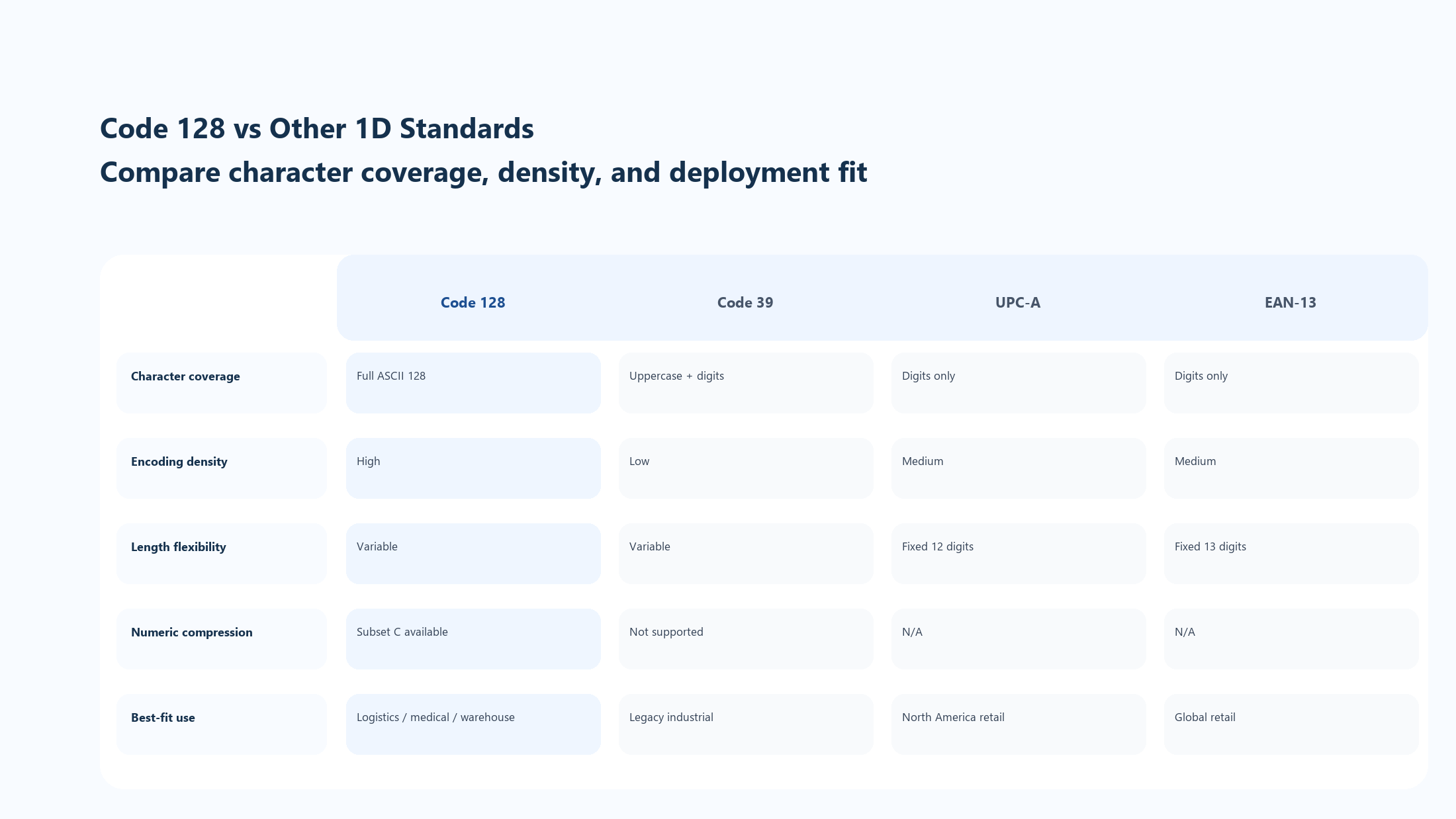
If you need strong character flexibility, compact density, and broad deployment value, Code 128 usually outperforms older linear barcode standards.
Code 128 vs. Other 1D Standards at a Glance
| Feature | Code 128 | Code 39 | UPC-A | EAN-13 |
|---|
| Character Set | Full ASCII (128 chars) | Upper + digits + 7 symbols | Digits only | Digits only |
| Case Sensitivity | Yes | No | No | No |
| Encoding Density | Very High | Low | Medium | Medium |
| Length | Variable | Variable | Fixed 12 | Fixed 13 |
| Numeric Optimization | Yes (Subset C) | No | N/A | N/A |
| GS1 Standard Derivative | Yes (GS1-128) | No | Yes | Yes |
Bottom line: if you're unsure which 1D barcode standard to use, Code 128 is almost always the safest default choice — combining the widest character coverage with the highest encoding efficiency, it adapts to virtually every industry scenario from logistics to retail to healthcare.