1. Scenario Introduction
In market acquisition pushes or physical asset tagging workflows, companies frequently require encoding colossal query variables (like ?utm_source=offline&asset_id=9876543210) onto QR Code stickers. However, porting long URLs directly engenders hyper-dense scanner textures while freezing the destination URL to physical media post-print. Assimilating short links tethered with QR rendering stands uniquely as the standard, compliant framework. This analysis unpacks the routing mechanics and rigid implementation limits anchored on the illi.io distribution stack.
2. The Physical Facts Capping Extended URLs
Generating native encodes for 200+ string-character lengths crashes into two insurmountable engineering barriers:
- Erosion of Corrective Overhead: Under identical dimensions, micro-pixel density radically destroys reading tolerances. Mild paper scratching or dirt specks seamlessly block scanner success, neutralizing even 30% H-Level compensations.
- Media Immutability: Paper holds read-only guarantees. If a campaign deprecates or backend APIs mutate routes, thousands of scattered PR tags abruptly expire, nullifying campaign ROIs entirely.
3. Translating Layer Engineering inside illi.io
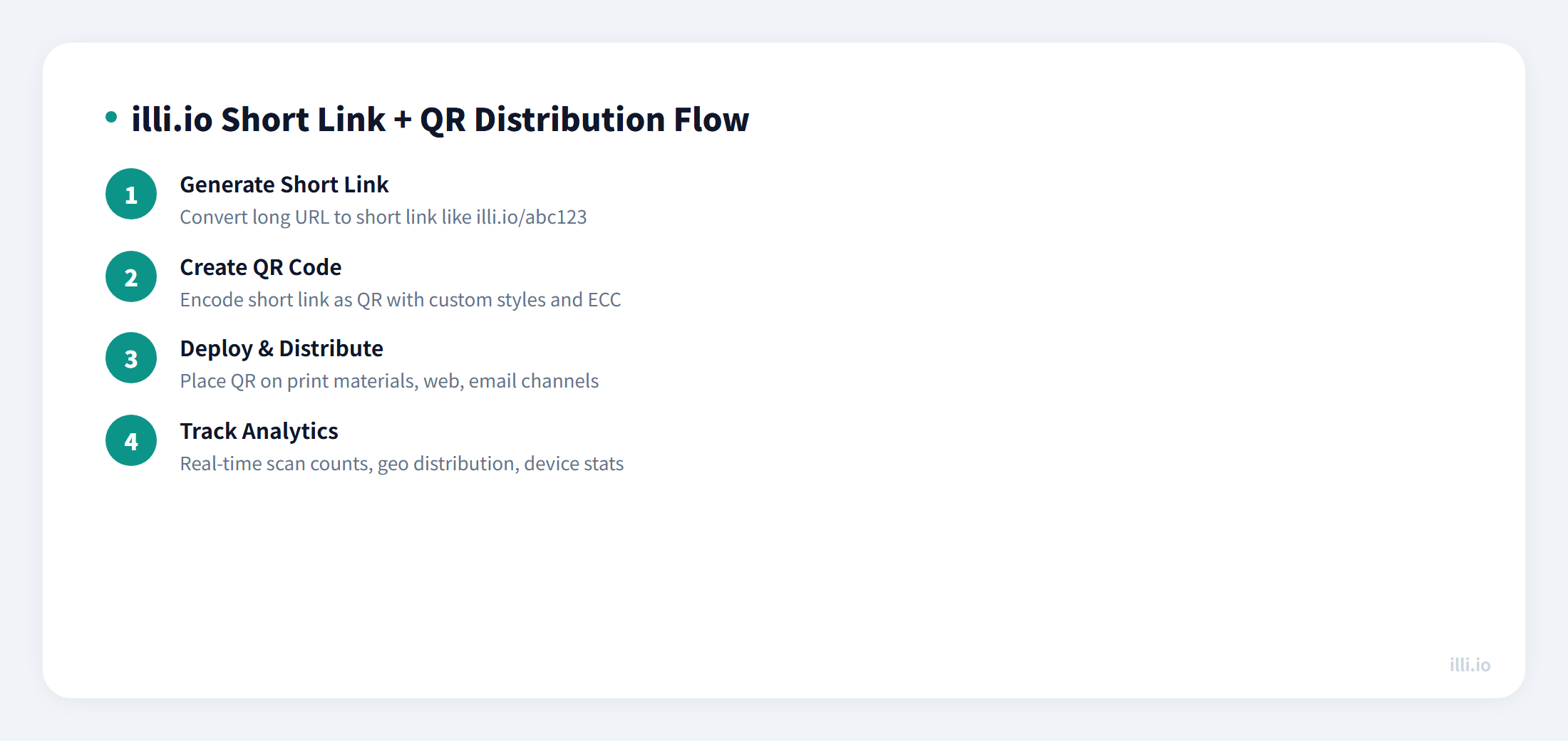
Utilities similar to illi.io establish a detached "Short-link Registration -> Dynamic Forward" staging layer, fundamentally decoupling traffic metrics from pure payload footprints.
3.1 Protocols regarding 301/302 Redirects
Scanning the URL abbreviation unfolds via sequential HTTP handshake protocols:
- Parser Firing: Devices decipher the micro URL (e.g.,
https://illi.io/xyz123). - Request Triggers: The client's mobile browser broadcasts a
GET request upon the short-link socket. - Backend Redirection: Matching server KV pairs, standard gateways broadcast
302 Found (Temporary) or 301 Moved Permanently responses, explicitly packing the massive true URL inside an HTTP headers' Location parameter. - Endpoint Loading: Responding inherently to routing protocols, endpoints transition exactly onto destination servers.
Protocol Alignment: For QR Codes anticipating real-time target adjustments, admins MUST demand HTTP 302 variants, evading heavy telecom cache layers natively storing 301 endpoints eternally.
3.2 Base62 Hash Encodings
Abstracting links demands numeric ID masking. Established patterns involve Ticket Server autoscaling ID tallies paired against an alphanumeric Base62 (a-z, A-Z, 0-9) radix encoding grid.
- Math Volumetric Tests: Single 6-digit Base62 identifiers mathematically support $62^6 \approx 56.8$ Billion independent aliases, effortlessly weathering colossal enterprise spikes. Deploying strictly this mathematical transformation restricts previously extensive chains beneath a hyper-compact 15 characters total.
4. Perimeters Covering Analytics Tracing
Pivoting static ink into Dynamic codes generates the secondary benefit of Data Ingestion. Throughout these handshake intervals, isolated servers map non-intrusive metadata points:
- User-Agent (UA) Metrics: Identifies device demographics (iOS versus Android splits), inside-brand engines (e.g., WeChat browsers), or third-party camera apps.
- Timestamp Deltas: Diagnoses exact time-of-day momentum spikes.
- IP Origins: Resolves client-facing origins scaling towards geolocation metrics (factoring marginal Carrier NAT variations).
Regulatory Blocks: Shackled by operating privacy sandboxes and browser firewalls, servers pull Exclusively lightweight HTTP Header streams. Active plots seeking high-precision GPS sensors or permanent digital identities strictly hit dead-ends devoid of OAuth authorizations.
5. Architectural Conclusion
Avoid pressing native maximum-density links across globally circulating physical surfaces. Leveraging the illi.io infrastructure logic securely diminishes graphical footprints, abolishes scan failures, and natively installs critical foundations for post-launch routing modifications alongside transparent feedback metrics. Implementation strategies merely demand rigorous oversight respecting redirect availability uptimes and domain TTFB speeds.
6. Security Risks and Mitigation for Short Links
The convenience of short links comes with inherent security concerns — users cannot see the actual destination URL before scanning. Here are common risks and corresponding mitigation strategies:
Phishing Protection
Malicious actors may create fraudulent short links that redirect users to phishing sites. Countermeasures include:
- Use trusted short link services: Choose providers with established reputations (like illi.io), and avoid unknown or disposable URL shorteners
- Preview feature: Some services let you append "+" to the short URL to preview the destination before visiting
- Enforce HTTPS: Ensure both the short link service and the destination page use HTTPS encrypted transport
Link Hijacking Prevention
If a short link provider shuts down or gets compromised, all QR codes using that service could be redirected to malicious sites. Risk mitigation includes:
- Choose providers with proven operational history
- For critical marketing materials, consider a self-hosted short link service on your own domain
- Periodically audit deployed short links to verify they still point to correct destinations
7. Pre-Deployment Checklist
Before putting short-link QR codes into production, verify each item:
- Scan testing: Test with at least 3 different phone brands to confirm redirects work correctly
- Print size: QR code physical dimensions should be no smaller than 2cm × 2cm (business cards) or 3cm × 3cm (posters) to ensure reasonable scanning distance
- Color contrast: Dark modules on light background — avoid color combinations with similar brightness levels
- Quiet zone: Maintain at least 4 module-widths of blank space around the QR code
- Landing page test: Confirm the destination page loads quickly and displays correctly on mobile devices
- Analytics verification: Confirm the short link dashboard is properly recording scan data
- Contingency plan: Have a documented process for when destination links need to be changed
During the first 48 hours after deployment, closely monitor scan data to confirm everything operates as expected. Use illi.io's dashboard to view real-time scan counts, device distribution, and geographic data.