If you are choosing a code format for a restaurant menu, product packaging, event signage, printed coupons, or private traffic funnels, the real question is not simply "how do I generate a QR code?" What matters is understanding which type of code should carry a link, which should carry a product identifier, and which should remain editable after printing. Thin content usually stops at the button click. Useful content explains trade-offs, failure points, and operational consequences.
This guide looks at QR codes, barcodes, and dynamic QR codes from a practical publishing perspective. The goal is to help you decide what to use, how to improve scan reliability, and how to publish code-related content that still has value months after it goes live.
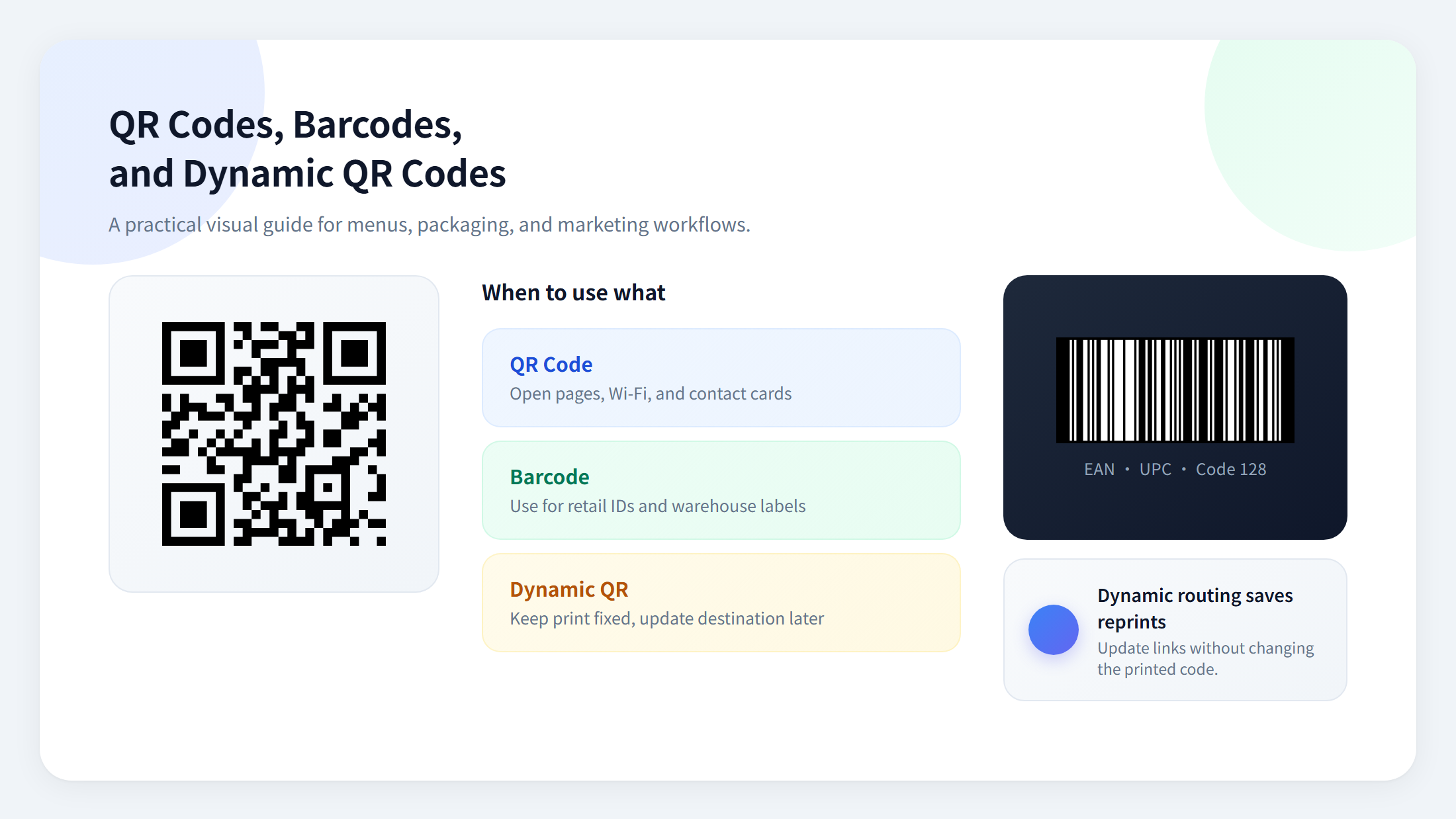
QR codes are best when you need to connect a physical touchpoint to a page, file, contact card, Wi-Fi profile, or campaign destination.
1. QR codes are best for connecting offline actions to online destinations
A QR code is a two-dimensional matrix that can hold URLs, plain text, contact data, Wi-Fi credentials, vCard payloads, and other compact data. Its biggest advantage is not visual novelty. Its real value is that it removes friction between a physical surface and a digital action. A user can scan once and immediately open a page, join a network, save a contact, start a download, or submit a form.
That is exactly why QR-related articles can carry long-term search value when they explain decisions instead of only describing a generator. Should a printed menu link to a PDF or a responsive page? Should a conference badge link to a vCard or a personal landing page? Should a campaign poster use a fixed link or a dynamic redirect? Those are practical questions with real cost implications.
- Menus, posters, landing pages, and event materials usually benefit from QR codes because the user needs to open a destination quickly.
- Wi-Fi sharing, contact cards, and lightweight configuration payloads also fit QR codes well because phones can scan them natively.
- One-time downloads, sign-up pages, and lead capture flows often convert better when you remove manual typing.
2. Barcodes are still foundational for retail, logistics, and inventory
Unlike QR codes, barcodes are usually designed for shorter and more structured identifiers: product numbers, asset IDs, lot numbers, order references, or warehouse labels. In retail checkout, warehouse sorting, and asset management, the one-dimensional barcode remains an infrastructure standard because it is inexpensive, compatible with older scanners, and deeply embedded in operational systems.
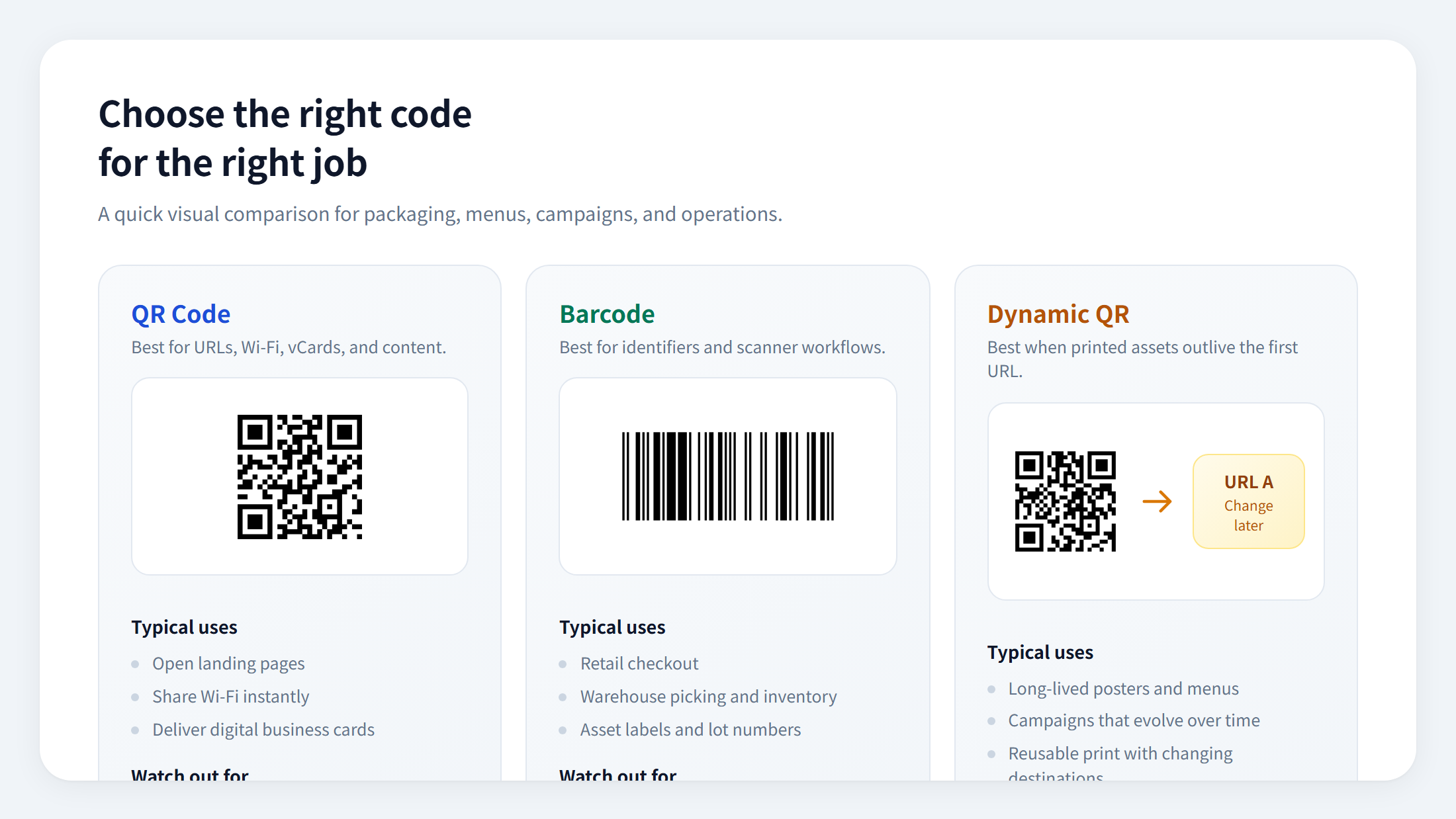
Barcodes remain the right choice for retail checkout flows, warehouse labels, and device-readable identifier systems.
Common formats such as EAN-13, UPC-A, Code 128, Code 39, and ITF differ in character support, checksum logic, industry acceptance, and scanner compatibility. Picking the wrong format does not just create a documentation issue. It can create failed scans at checkout, wasted labels, slower stock movement, or avoidable reprints.
- For consumer retail products, EAN-13 or UPC-A are often necessary because downstream scanners expect those standards.
- For internal warehouse or asset tags, Code 128 is often more flexible because it supports richer identifiers.
- For logistics workflows, the correct decision depends on the scanners and software already used by your downstream partners.
3. Dynamic QR codes matter when your destination changes after printing
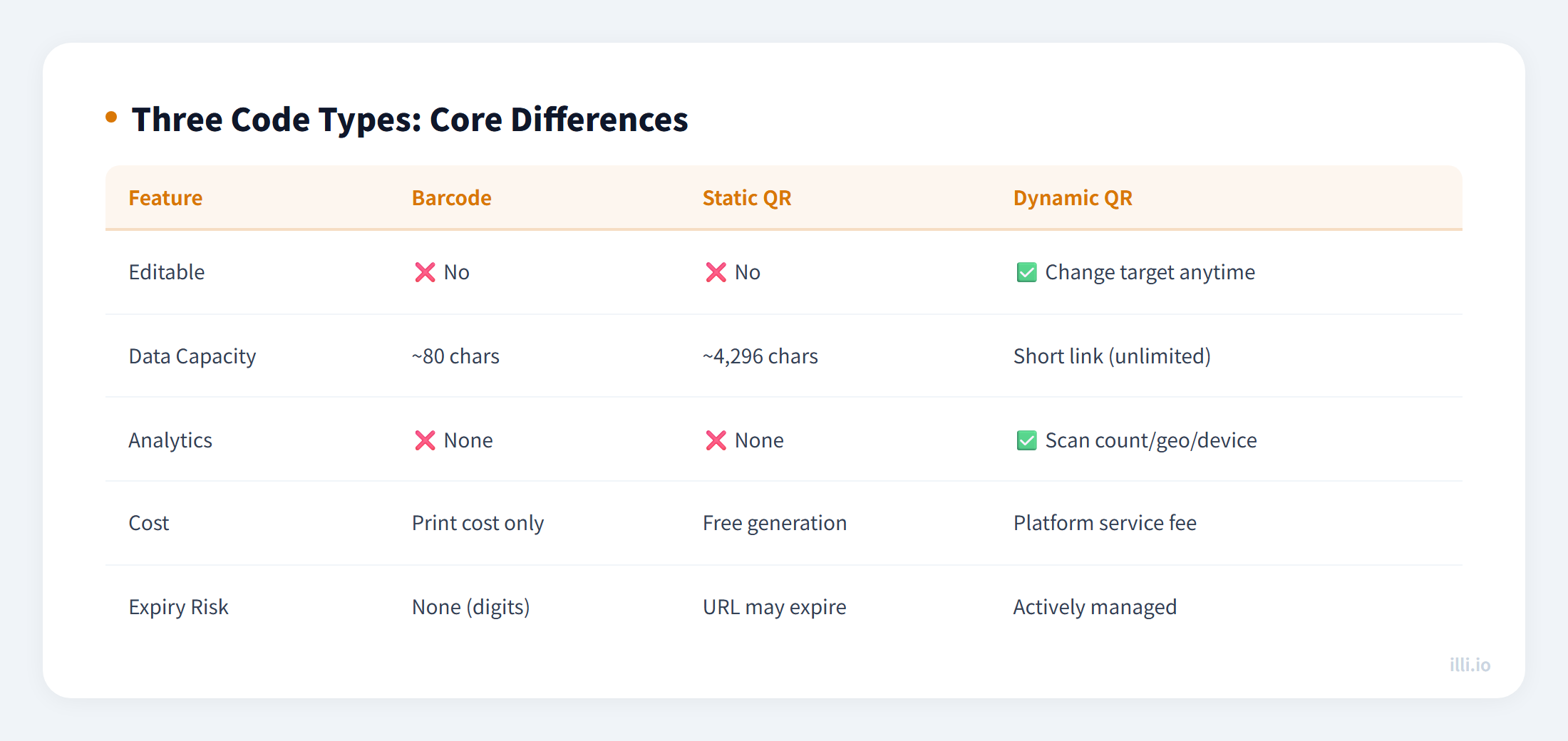
A dynamic QR code, sometimes described as a live code, keeps the visible code unchanged while letting you update the destination behind it. A static QR code hardcodes the final target. A dynamic QR code adds a redirect or routing layer so that the printed graphic can stay in circulation even when the destination changes.
That sounds like a small technical detail, but it has major operational value. If you have already printed five thousand flyers and the campaign page changes, a static QR code can turn your entire print batch into waste. A dynamic QR code can preserve the material and shift the destination without redesigning or reprinting.
- Short promotions benefit from dynamic routing because pages change by season, time range, or inventory state.
- Multi-channel campaigns benefit because the same poster can be reused while the target experience evolves.
- Private traffic operations benefit because support channels, group links, or form endpoints often change over time.
At the same time, dynamic QR systems must be stable, fast, and compliant. A good article should never stop at "dynamic is better." It should also mention redirect latency, fallback planning, privacy handling, and the risk of chaining too many hops before the final page loads.
4. A simple decision framework: QR code, barcode, or dynamic QR code?
| Scenario |
Recommended format |
Why |
| Restaurant menus or campaign pages | QR code or dynamic QR code | The user needs to open a destination page, and content often changes later. |
| Retail product packaging | Barcode | Checkout, stock systems, and existing scanners depend on standard product identifiers. |
| Wi-Fi, contact cards, and profile sharing | QR code | Phones can act on the data directly without manual typing. |
| Long-lived posters and expo materials | Dynamic QR code | It reduces waste when the target URL changes after printing. |
5. The scanability details that matter more than visual decoration
Many tutorials show where to click but do not explain why a printed code fails in the real world. These practical details matter far more than decorative gradients:
- Leave enough quiet zone around the code so the scanner can detect the shape correctly.
- Do not shrink the code too aggressively on packaging, table signs, or hanging tags.
- Preserve strong contrast: dark modules on a light background remain the safest default.
- Control payload size because dense QR matrices become harder to scan on lower-end devices.
- Print and test the code in the actual material, size, and lighting conditions before release.
6. What makes code-related content genuinely valuable instead of thin
If you operate a QR or barcode utility site, repeating "click here to generate" does not build much editorial value. Higher-value content explains standards, compares scenarios, warns about expensive mistakes, and gives readers a way to verify success before launch.
- Explain why standards differ and when Code 128 cannot replace EAN-13.
- Map recommendations to real industries such as hospitality, logistics, ecommerce, exhibitions, and internal ops.
- Show common failure cases such as dead links, unreadable print sizes, or wrong scanner compatibility.
- Offer a checklist that readers can use immediately before publishing or printing.
The real goal is not word count. It is helping people avoid wasted materials, failed scans, broken redirects, and unnecessary rework. When an article answers "why this format," "what can go wrong," and "how to validate it," it stops being thin content.
7. A pre-publish checklist you can actually use
- Define the goal first: page visit, configuration transfer, or device-readable identifier.
- Choose the correct format: QR code, barcode, or dynamic QR code.
- Check payload length and avoid stuffing long content directly into a QR code.
- Prepare a fallback destination, especially for campaign pages and dynamic routes.
- Test with at least two phones and one common scanner before printing at scale.
8. Useful tool entry points
If you are working on a real project right now, the following tools can help you generate and validate your assets:
In short, QR codes connect people to content, barcodes move structured identifiers through systems, and dynamic QR codes add flexibility for long-lived printed assets. When those three roles are explained clearly and tested carefully, code-related content becomes genuinely useful instead of disposable.