What is a Public IP
A public IP address is assigned by an ISP and can be accessed directly from the internet. It is globally unique and commonly used in broadband connections, cloud servers, and remote access scenarios.
- Pros: Globally unique, direct remote access.
- Cons: Limited availability, usually requires extra cost.
What is a Private IP
A private IP address is used within a local area network (LAN) and cannot directly access the internet. It requires NAT to communicate with public networks. Common ranges include:
- 10.0.0.0 - 10.255.255.255
- 172.16.0.0 - 172.31.255.255
- 192.168.0.0 - 192.168.255.255
- Pros: Free, reusable within LAN.
- Cons: No direct internet communication.
Main Differences
| Aspect | Public IP | Private IP |
|---|
| Uniqueness | Globally unique | Unique only in LAN |
| Internet Access | Direct | No, requires NAT |
| Common Usage | Servers, remote access | Home or corporate networks |
| Cost | ISP assigned, usually charged | Free |
| Quantity | Limited | Abundant |
Network Topology Diagram
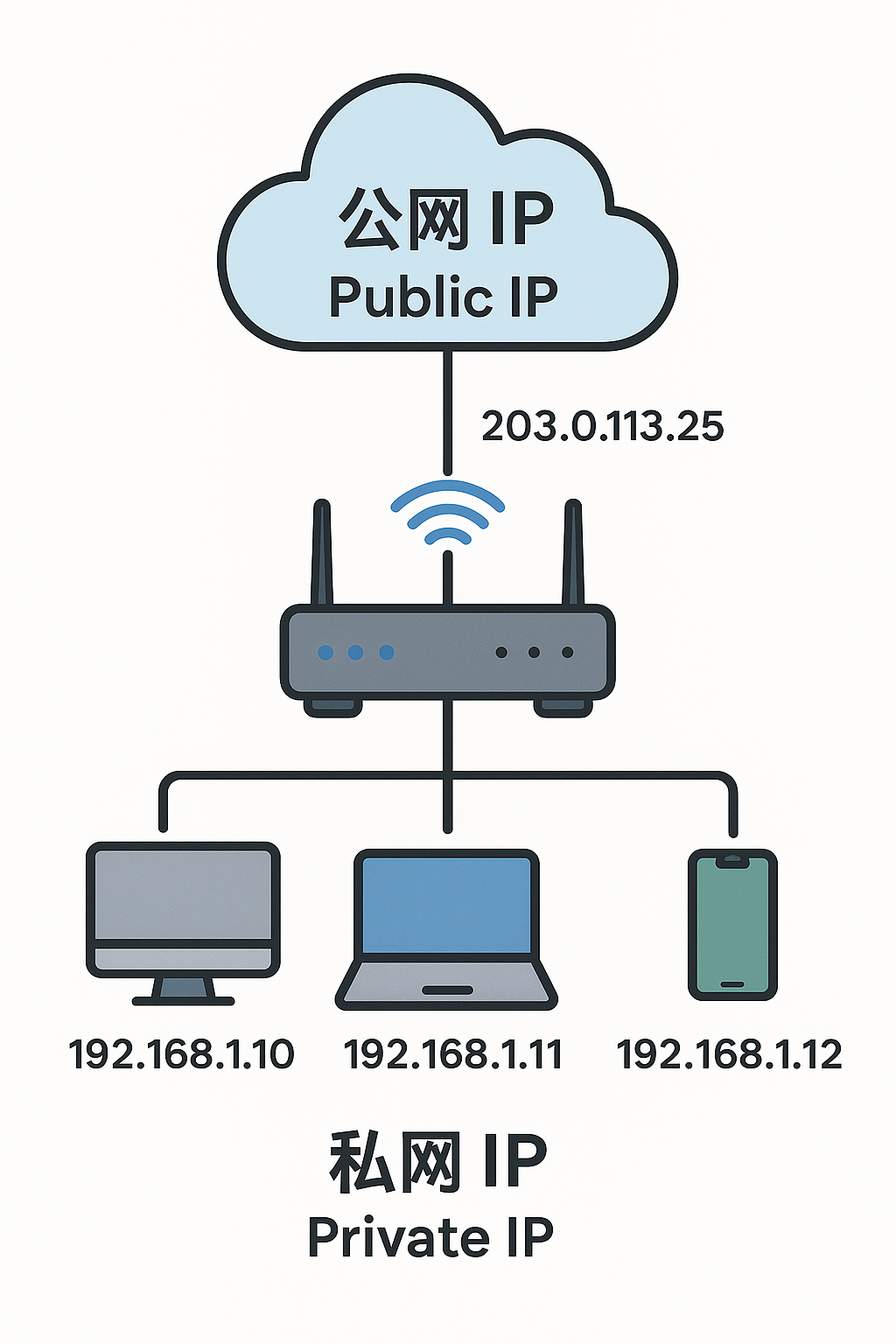
The following diagram shows the relationship between public and private IPs: a router connects to the internet with a public IP and assigns private IPs to devices within the LAN.
Use Cases
Public IP: Hosting websites, remote access, cloud services.
Private IP: Home WiFi, corporate LAN device communication.
You can check your IP address or generate a QR code using the following online tools:
Conclusion: Public IPs act like an "internet ID card," while private IPs are like "house numbers" in a LAN. Knowing the difference helps in better network setup and management.
NAT and Why Your Local IP Never Reaches the Internet
Network Address Translation (NAT) is the technology that makes private IP addresses work on the public internet. Your router maintains a translation table mapping each private IP:port combination to the router's public IP:port. When a packet leaves your network, the router rewrites the source address from your private IP to its public IP. When a response arrives, it reverses the translation and forwards the packet to the correct internal device. From the internet's perspective, all traffic from your home appears to originate from a single public IP.
Implications for Security and Remote Access
The NAT boundary acts as an implicit firewall for inbound connections: unsolicited packets from the internet cannot reach your private devices because the router does not know which internal IP to forward them to. This is why port forwarding is required to host a server at home — you are explicitly punching a hole in the NAT boundary for a specific port. Understanding this distinction also clarifies why connecting via VPN changes your apparent public IP: your traffic now exits through the VPN server's public IP rather than your home router's.