Everyone recognizes QR codes, but another 2D barcode — Data Matrix — is equally indispensable in industrial applications. Both encode large amounts of data in small areas, but their design philosophies, error correction approaches, and ideal use cases differ significantly. This article provides a thorough technical comparison.
Encoding Principles
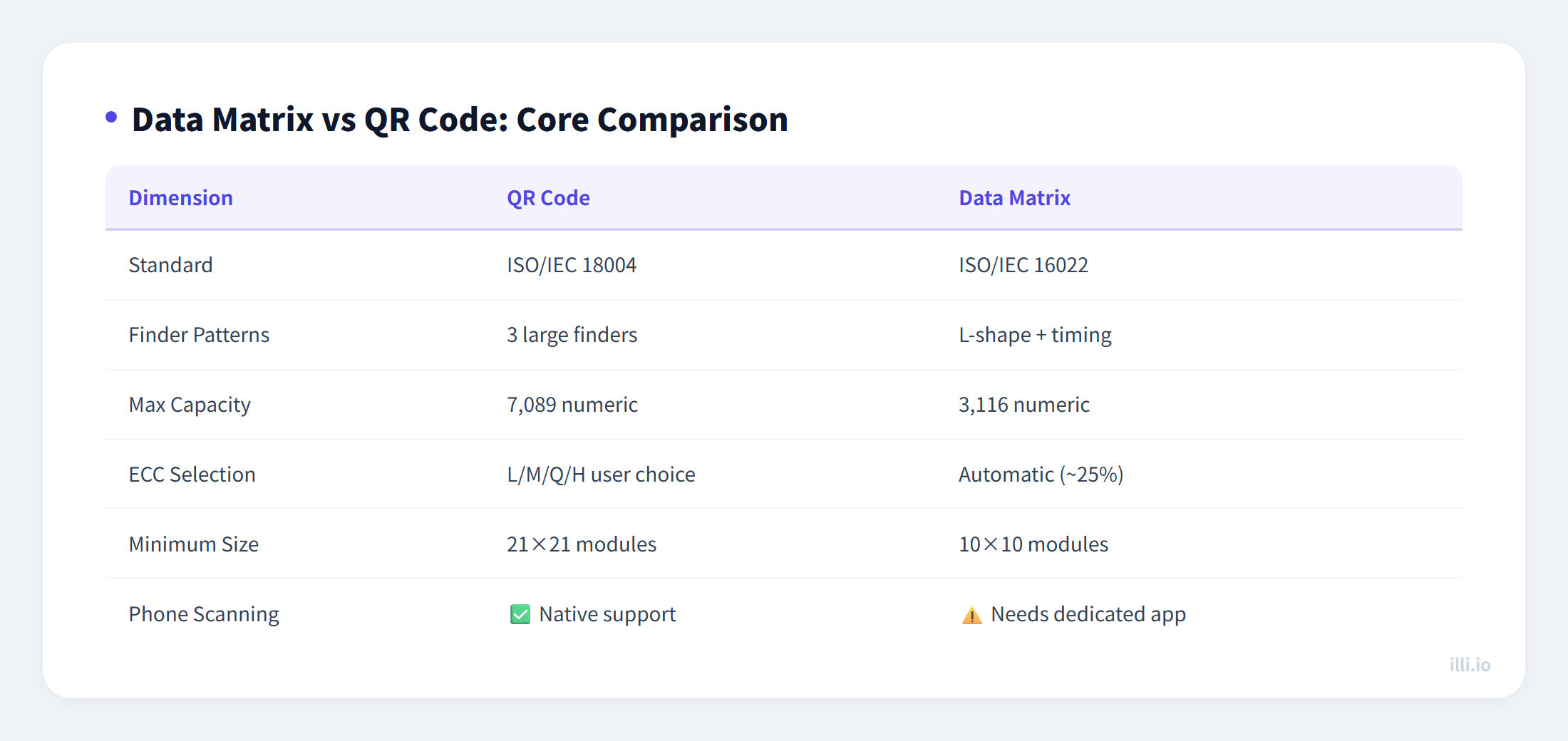
QR Code (ISO/IEC 18004) uses Reed-Solomon error correction with three large Finder Patterns at corners for rapid orientation. It supports numeric, alphanumeric, kanji, and binary encoding modes. Versions 1-40, max capacity 7,089 numeric characters.
Data Matrix (ISO/IEC 16022) also uses Reed-Solomon but replaces large finder patterns with an L-shaped Finder Pattern and alternating Timing Pattern. ECC 200 is the only recommended version today, max capacity 3,116 numeric characters.
Core Parameter Comparison
Error Correction Comparison
QR Code offers 4 ECC levels (L/M/Q/H, 7%-30%) for user selection. Data Matrix ECC 200 automatically calculates its error correction — roughly equivalent to QR's Q level (~25%) — without requiring user choice.
The critical difference: Data Matrix maintains high error correction at extremely small sizes because it does not need three large Finder Patterns consuming space. This is why electronic components almost always use Data Matrix rather than QR Code.
Industry Applications
| Industry | Recommended | Reason |
|---|
| Consumer Marketing | QR Code | Native phone support, excellent UX |
| Electronics Marking | Data Matrix | Printable on 2mm×2mm surfaces, laser-etchable |
| Pharma Traceability | Data Matrix | GS1/FDA designated format, UDI regulation |
| Aerospace | Data Matrix | MIL-STD-130 specified, extreme environment tolerance |
| Logistics | QR Code | Higher capacity, supports CJK encoding |
| Automotive Parts | Data Matrix | AIAG standard, ideal for Direct Part Marking |
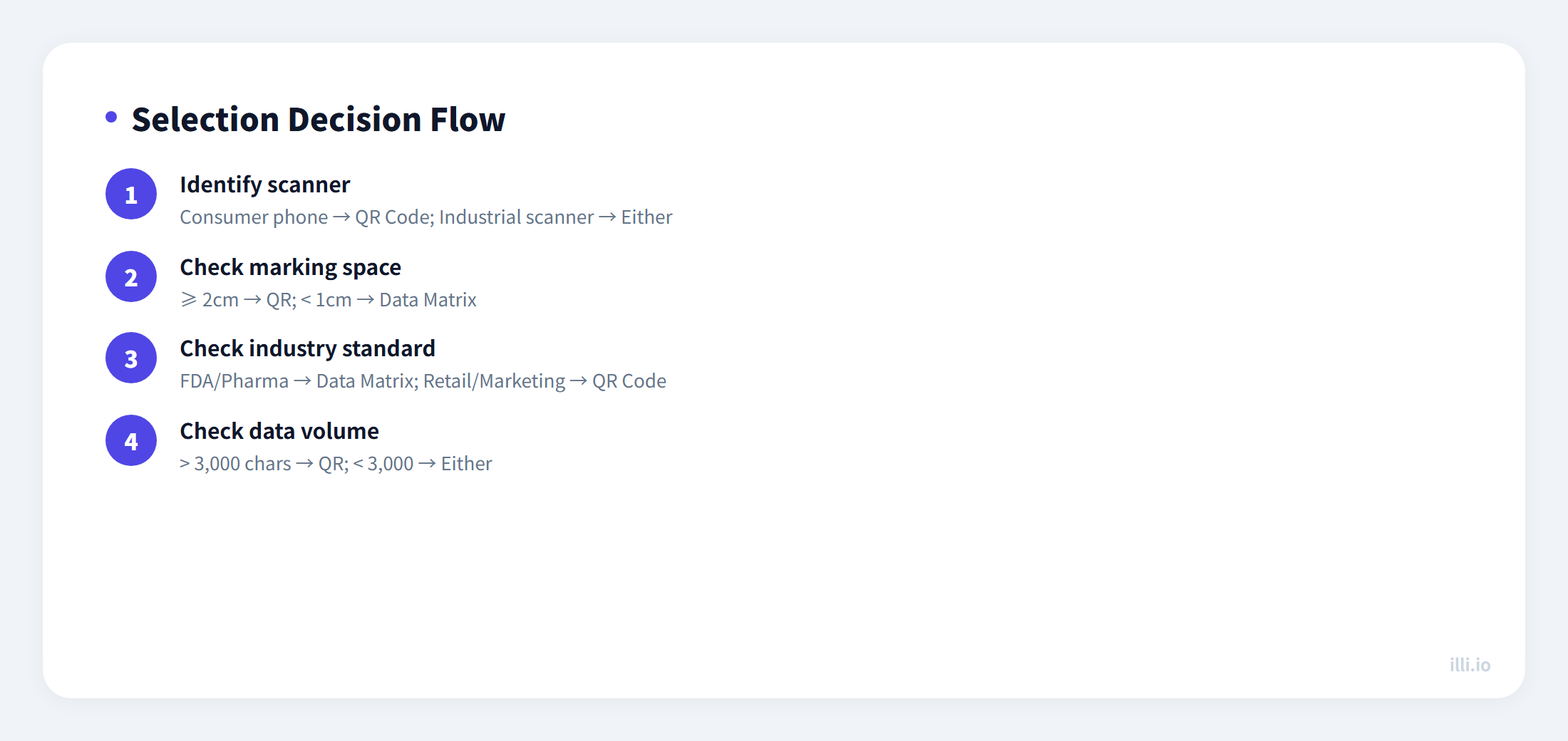
Decision Framework
Common Misconceptions
Myth 1: "Data Matrix is outdated" — Quite the opposite. The FDA has required Data Matrix UDI labels on all medical devices since 2023.
Myth 2: "QR Code has better error correction" — Only when H-level is selected. Data Matrix ECC 200 defaults to robust correction (~25%) without requiring user configuration.
Myth 3: "They're interchangeable" — Consumer phones typically cannot scan Data Matrix without a dedicated app, while industrial scanners support both.