The barcode on supermarket shelves has been around for 50 years. Now, a quiet revolution is underway: GS1 Digital Link is replacing traditional barcodes with QR codes, turning every product into an internet gateway. Starting 2027, global retail will begin transitioning from legacy barcodes to GS1 QR codes.
Limitations of Traditional Barcodes
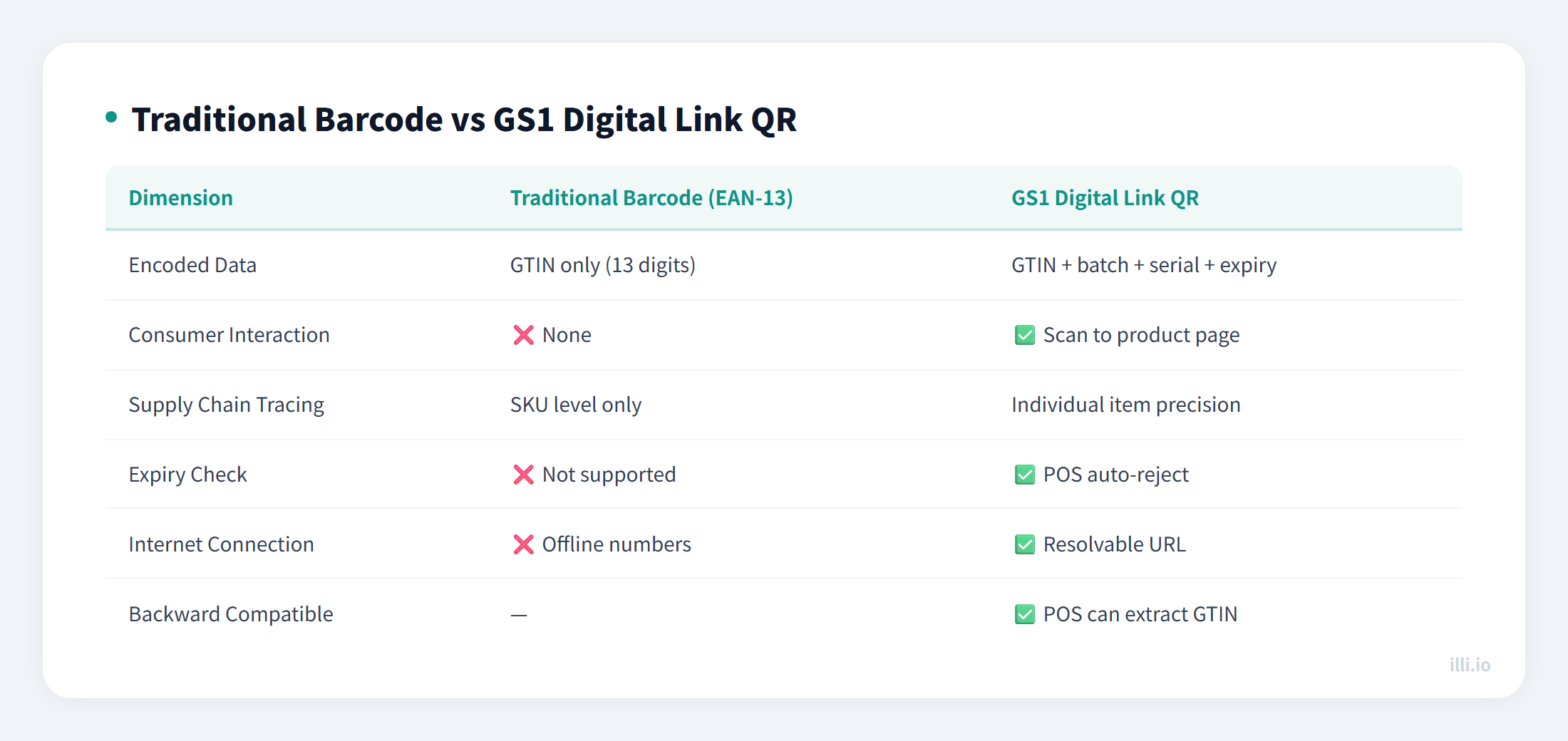
Current EAN-13/UPC-A barcodes have fundamental constraints:
- Encodes only GTIN: A number string that only identifies "what product this is"
- No batch/serial numbers: Cannot trace back to specific production lots
- No expiry date: POS cannot automatically reject expired products
- No internet connection: Consumer scanning yields just a number string
What is GS1 Digital Link
GS1 Digital Link is a standardized URL structure that encodes GTIN and other identifiers in a resolvable web address:
https://id.gs1.org/01/04006381333931/10/LOT123/21/SN456
This URL encodes:
01/04006381333931 — GTIN (product identification)10/LOT123 — Batch number21/SN456 — Serial number
Encoding this URL as a QR Code creates a single code that serves:
- POS checkout: Scanner extracts GTIN, backward-compatible with barcodes
- Consumer engagement: Phone scan opens product page, nutrition info, instructions
- Supply chain traceability: Batch + serial numbers enable end-to-end tracking
- Expiry checking: Encoded expiry data lets POS auto-reject expired items
Comparison with Traditional Systems
Global Transition Timeline
| Year | Milestone | Impact |
|---|
| 2024 | GS1 Sunrise initiative launch | Retailer POS must support 2D barcode scanning |
| 2025-2026 | Early adopter brands migrate | Some products carry both barcode and QR code |
| 2027 | Legacy barcode phase-out begins | New products prioritize GS1 Digital Link QR |
| 2030+ | Full transition | Barcodes gradually exit retail |
Technical Implementation
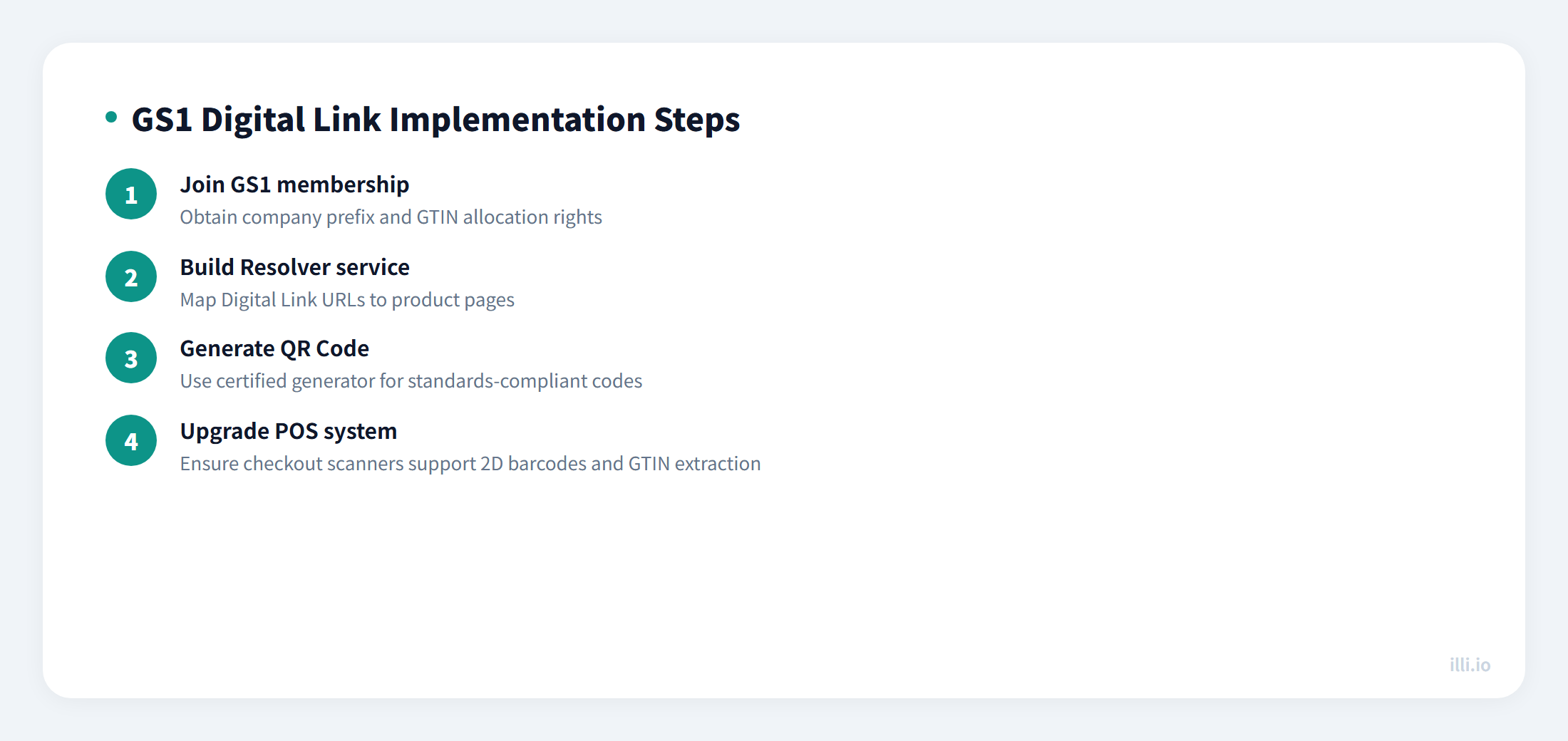
For brands and technical teams, implementing GS1 Digital Link requires attention to:
- Resolver service: Build or use third-party GS1 Resolver to redirect Digital Link URLs to product pages
- QR quality: Retail requires minimum X-dimension 0.33mm, ECC level M or higher
- Backward compatibility: POS scanners must extract GTIN from Digital Link URLs
- Data carrier: GS1 recommends QR Code, but Data Matrix is also accepted (especially in pharma)
What This Means for Consumers
In the future, scanning a product QR code will not just show a number — it will provide:
- Instant access to ingredients and nutrition information
- Product authenticity verification (anti-counterfeit traceability)
- Product recall notifications
- Usage tutorials and after-sales support
- Sustainability information (carbon footprint, recycling guides)
If your brand is planning QR-based marketing, illi.io generates high-quality QR codes quickly. While full GS1 Digital Link implementation requires a backend Resolver service, getting consumers accustomed to "scan for more info" now is a wise strategy.