Why Check Digits Exist: Scanning Is More Than Reading Lines
When a barcode is scanned at a supermarket checkout, the scanner doesn't just read the black-and-white lines — it also performs an instantaneous mathematical verification. The last digit of the barcode isn't part of the product information; it's a check digit computed by an algorithm. Its sole purpose is to confirm that all preceding digits were scanned correctly, preventing errors caused by smudged ink, worn labels, or optical interference.
If the calculated check digit doesn't match the barcode's final digit, the scanner immediately flags "invalid read" and requests a rescan — this is one of the most fundamental data integrity safeguards in the retail supply chain.
The Modulo-10 Algorithm (Luhn Variant): Full Walkthrough
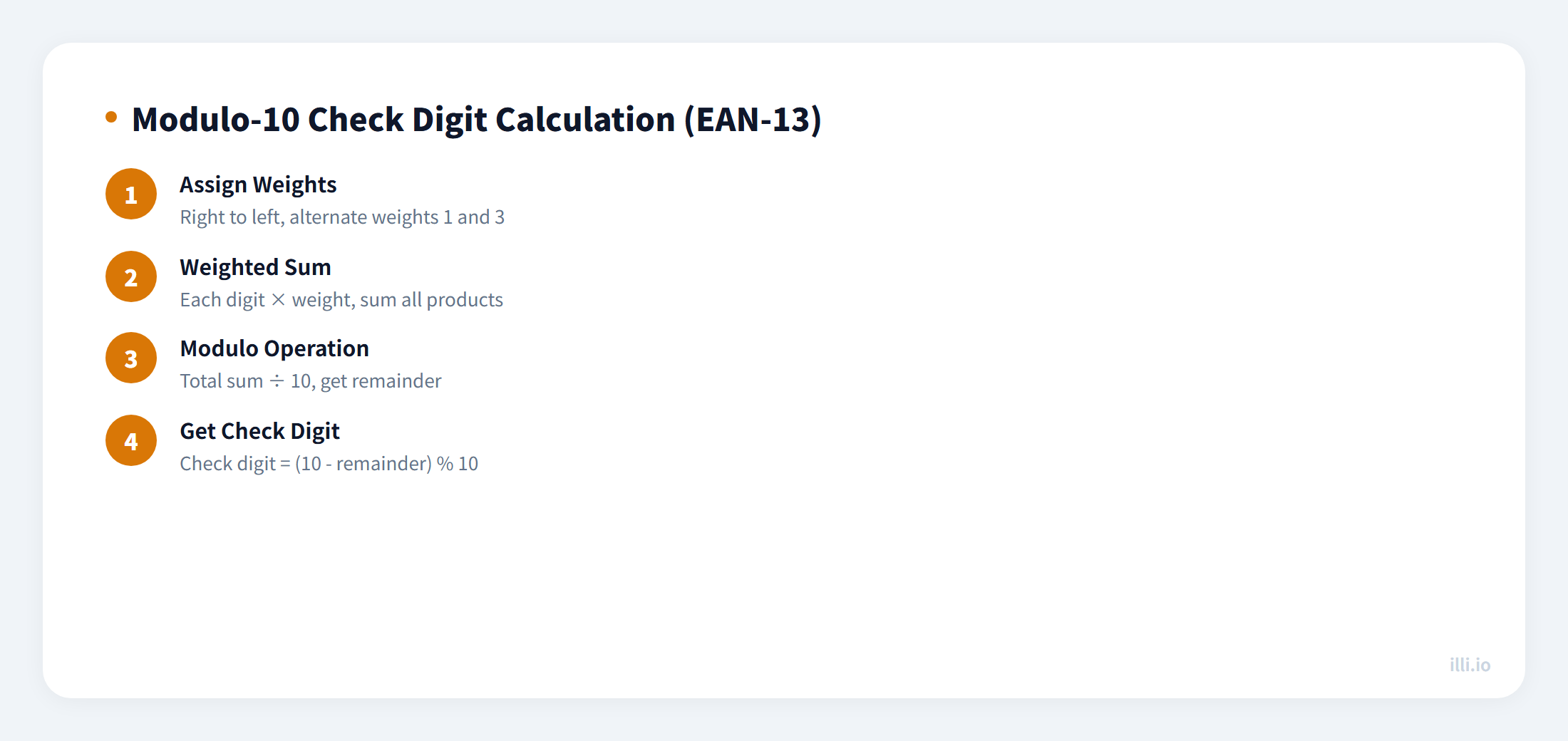
The check digit algorithm used by EAN-13 and UPC-A is essentially the same Weighted Modulo-10 Checksum. Here's a complete walkthrough using EAN-13 as an example.
Example: Calculate the check digit for EAN-13 code 690123456789?
The first 12 known digits are: 6 9 0 1 2 3 4 5 6 7 8 9
Step 1: Assign Weights
From left to right, assign alternating weight factors of 1 and 3:
| Position | 1 | 2 | 3 | 4 | 5 | 6 | 7 | 8 | 9 | 10 | 11 | 12 |
|---|
| Digit | 6 | 9 | 0 | 1 | 2 | 3 | 4 | 5 | 6 | 7 | 8 | 9 |
| Weight | 1 | 3 | 1 | 3 | 1 | 3 | 1 | 3 | 1 | 3 | 1 | 3 |
Step 2: Multiply and Sum
Multiply each digit by its weight, then add all products:
(6x1) + (9x3) + (0x1) + (1x3) + (2x1) + (3x3) + (4x1) + (5x3) + (6x1) + (7x3) + (8x1) + (9x3)
= 6 + 27 + 0 + 3 + 2 + 9 + 4 + 15 + 6 + 21 + 8 + 27 = 128
Step 3: Modulo 10
128 mod 10 = 8 (128 divided by 10 leaves remainder 8)
Step 4: Subtract from 10
10 - 8 = 2
If the result equals 10, the check digit is 0; otherwise, the result is the check digit.
Final result: Check digit = 2, complete EAN-13 code is 6901234567892
UPC-A Check Digit Calculation
The UPC-A check digit algorithm is identical to EAN-13's, but operates on 11 digits (total length 12, last digit is the check digit). The alternating weight rule is the same: position 1 gets weight 3, position 2 gets weight 1, position 3 gets weight 3... (note that UPC-A's first position weight is 3, opposite to EAN-13).
Mathematically, UPC-A code 012345678905 equals EAN-13 code 0012345678905 — prepend a zero to convert to standard 13-digit EAN, and the check digit remains the same.
Why Weights 1 and 3 Specifically?
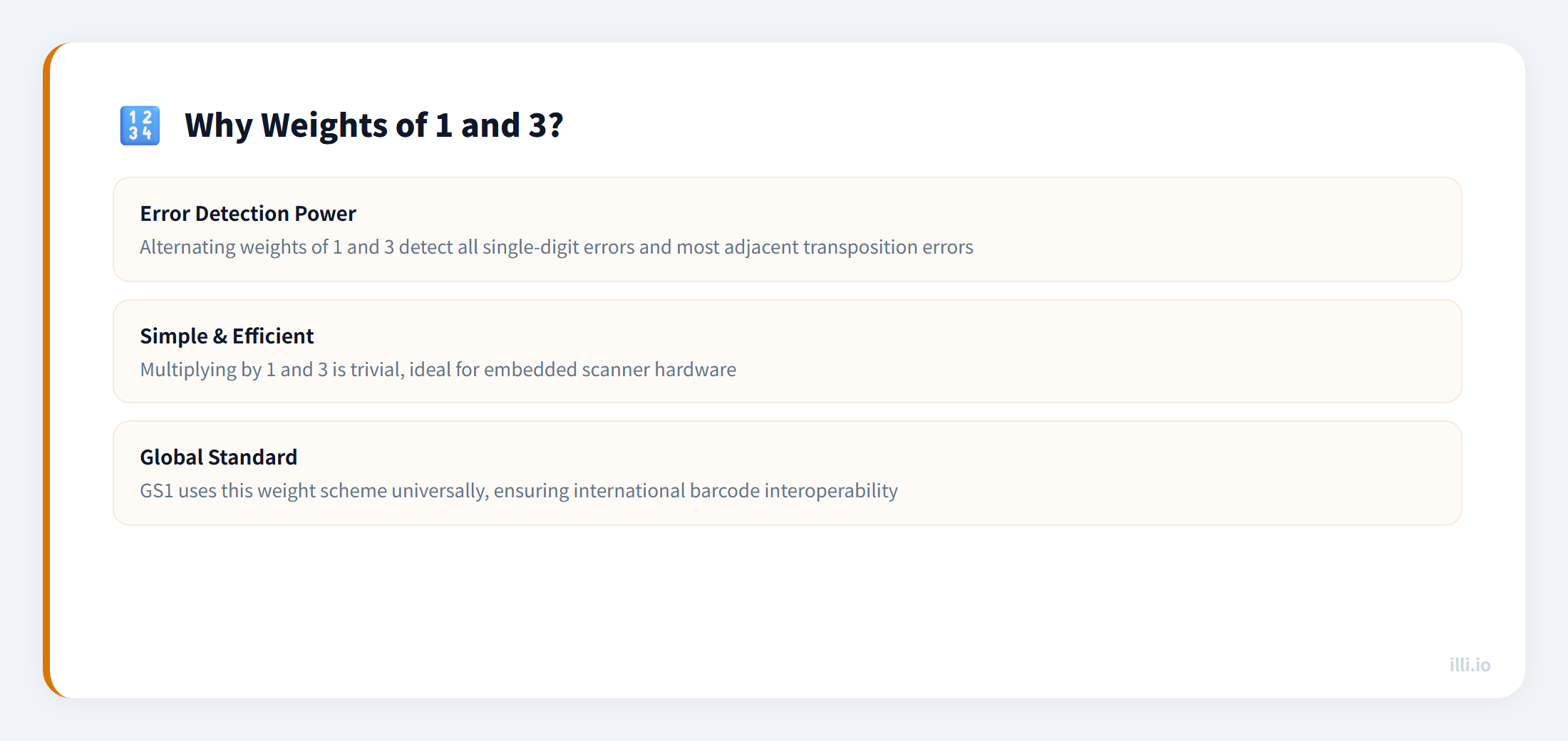
This particular 1-3 alternating weight scheme has mathematical advantages:
- Detects 100% of single-digit substitution errors (any single digit misread as another)
- Detects approximately 90% of adjacent transposition errors (two neighboring digits swapped) — the second most common barcode scanning error type
If equal weights were used (all weights = 1), transposition errors would be completely undetectable — "12" and "21" have the same equal-weight sum.
Verify Your Barcode on illi.io
If you have a barcode that needs check digit verification, the quickest method is to enter your number in the barcode generator on illi.io — the system automatically calculates and appends the correct check digit. If your manually entered check digit doesn't match the system's calculation, the original barcode contains a printing error or scanning inaccuracy.
Common Errors and Troubleshooting
- Check digit mismatch: The most common cause is visual confusion during manual entry — mistaking "6" for "8", "1" for "7", etc. Verify each digit against the original
- Wrong digit count: EAN-13 must be exactly 13 digits, UPC-A must be exactly 12 digits. One digit too many or too few causes validation failure
- Reversed weight direction: EAN-13's first digit weight is 1 (not 3). UPC-A's first digit weight is 3 (not 1). Reversing the direction produces an incorrect check digit